What's Being Discussed for Detroit's Renaissance Center and East Riverfront?

By E4 The Culture
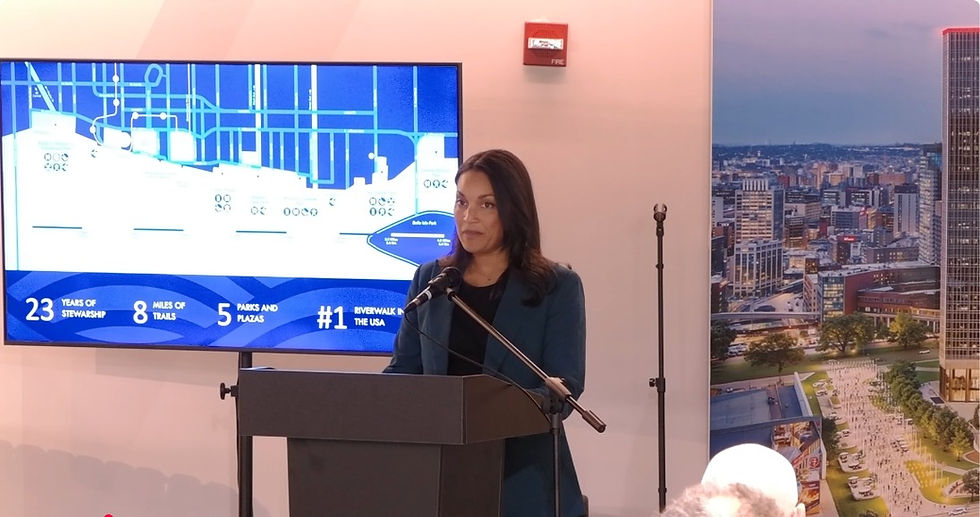
E4 The Culture's recording of the community session. Presentation material includes a conceptual development display.
Detroit's riverfront future is about more than what might replace a parking lot or change the skyline. It is also about how residents reach the water, which activities belong there, and whether the resulting spaces work for people with different ages, abilities and reasons for visiting.
E4 The Culture recorded the presentations, panel discussion and Q&A from a public-space and placemaking session at the East Riverfront Community Hub. The Detroit Riverfront Conservancy's official event listing identifies the session as September 30, 2026, at 521 Atwater Street, organized with Bedrock, General Motors and the Gilbert Family Foundation.
The recording captures a discussion of proposals and community priorities. It does not document a final construction plan or establish that every idea shown will be built.
The key distinction: a vision is not a finished plan
In E4's recording, presenters describe a broader reimagining of the Renaissance Center and nearby East Riverfront. Public space, housing, hospitality, recreation and access to the water appear within that discussion. Their relationship matters: a riverfront district cannot be understood only through its buildings, or only through its open spaces.
During the Q&A, Bedrock's responding presenter explains that the illustrated arrangement remains open to interpretation. Buildings, pathways, marina locations and swimming concepts still need design work. Community and stakeholder input is intended to influence the instructions given to planning and design teams.
That is the right way to read the visuals in the presentation: as a way to discuss possibilities. A rendering can make an idea understandable without making it an approved commitment.
Separately, the City of Detroit's Renaissance Center and East Riverfront project page describes a proposed redevelopment undergoing the Community Benefits Ordinance process. The public-space session and that formal process are related opportunities for engagement, with different purposes. Attending a placemaking conversation is not the same as approving a development or securing a particular community benefit.
What was presented—and what the timeline means
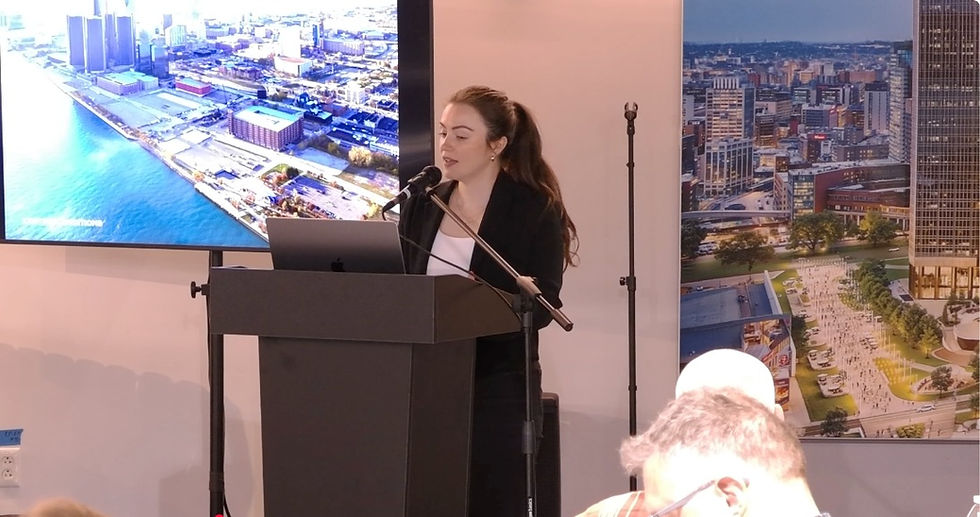
Development concepts presented during the session; the rendering is proposal material, not completed construction. Image captured from E4's event recording.
The opening presentations connect the redevelopment discussion to the riverfront's existing public spaces and programming. The panel then shifts attention to how those spaces are used: wellness, recreation, cultural activity and community connection.
In the recorded Q&A, the presenter outlines a phased, roughly ten-year vision. He describes keeping the site available through the 2027 Final Four and Grand Prix, followed by a first phase extending through the end of 2031 and further phases discussed for 2034 and 2036.
Those are the milestones described at this meeting, not E4's guarantee of a construction schedule. Design, approvals, infrastructure coordination and subsequent decisions can affect what happens and when. Readers seeking the latest formal project status should use the City's page rather than treat this recording as a live schedule.
The Grand Prix discussion has a similar limit. The answer describes a commitment through 2027 and conversations about a potential return after substantial development. It does not announce a settled future course, paddock location or event agreement beyond that period.
Accessibility starts before someone reaches the water
A public space can be open in principle and difficult to use in practice. E4's recording returns to that difference through questions about getting to the riverfront and moving through it.
The panel discusses inclusive wellness programming, including activities that account for mobility, hearing and visual access. Year-round recreation also comes up. A space that works only during good summer weather may leave important community needs unmet.
The Q&A raises the practical overlap between people strolling, people riding bikes or e-bikes, and people with mobility challenges. The response discusses potential opportunities to expand public corridors and distinguish pedestrian and bicycle movement. These are ideas under consideration, not a completed lane design.
For residents, useful questions remain concrete: Can someone reach the space comfortably? Can they cross the streets around it? Can people moving at different speeds share the area safely? Can an activity be used by someone whose access needs differ from those of the person designing it?
Transportation, mobility and infrastructure
The discussion connects riverfront access to I-375 and Jefferson Avenue. In the recording, the presenter describes coordination with transportation projects, connections into existing parking facilities, and a preference for making the southern part of the district more centered on pedestrians.
He also clarifies that this does not mean eliminating all vehicle access. That distinction matters for visitors, residents, deliveries and people who need accessible arrival options.
E4 is reporting what was discussed at the session. This article does not independently establish the approval status, engineering details or construction schedule of a separate transportation project. Nor does mentioning coordination mean that the development team controls every infrastructure decision.
The practical issue is the connection between downtown, neighborhoods and the water. A new destination will be more useful if reaching it is straightforward, rather than requiring awkward routes through streets and parking areas.
Recreation, public space and programming

Community discussion captured in E4's recording of the same event. The backdrop is a conceptual rendering.
The panel shows why public space is more than an architectural drawing. Programs and community habits help determine whether people feel that a place belongs to them.
Nolan Edwards of Motown Roller Club participates in the recorded panel's skating discussion. Dr. Michelle Renaud of Urban Solace contributes a wellness perspective. Urban Solace's own organization biography confirms her identity and its emphasis on accessible wellness experiences.
E4's recording includes interest in all-season recreation, inclusive activities and spaces that can support community programming. It also captures questions and ideas about skating, entertainment and access to the water. An idea raised in the room should be understood as input, even when it is appealing or appears in a conceptual illustration.
The resident-focused test is whether a place supports ordinary use as well as special events: a walk, a class, a gathering, a winter activity, or time near the river without needing a major occasion.
Sustainability and the riverfront environment
Questions about shade, heat, recycling, remediation and extreme weather appear in the recorded Q&A. The response discusses replacing impervious surfaces with landscaping and improving stormwater handling, alongside potential use of existing utility infrastructure.
Some environmental commitments are described as matters that could emerge through the community-benefits process. E4 has not treated these possibilities as finalized requirements or measured environmental outcomes.
For readers, this is an important follow-up area: which environmental ideas become specific commitments, how they are designed, and how their performance will be assessed. A greener-looking rendering alone does not answer those questions.
What Detroit residents asked
The recorded questions focus on consequences people can recognize: when new spaces might open, what happens to the Grand Prix, how transportation connects to the district, whether the renderings can change, how different users move along the Riverwalk, and how the environment will be considered.
These questions make the meeting valuable beyond the presentation itself. They expose the distance between a broad vision and the choices that will shape everyday experience.
E4 intentionally paused recording during the approximately twenty-minute breakout/group exercise. Part 1 ends as that activity begins; Part 2 resumes for Q&A and closing remarks. This article does not claim to report every table's discussion, every idea submitted, or an uninterrupted record of the evening.
What happens next—and how to stay involved
Residents can follow two complementary paths:
Use the official Detroit Riverfront development site to find project information and current community-engagement opportunities.
Use the City's project page linked above for the formal community-benefits process, meeting information and updated public materials.
Check those sources for current dates before making plans. Relative references in the recording—such as “next week”—belong to the date of the meeting.
As the process advances, the useful questions are which community priorities reach the design, which proposed benefits become commitments, and how future decisions explain changes from the early concepts. E4 The Culture's role is to preserve the discussion and help Detroiters follow those distinctions.
Watch the E4 The Culture recording
Part 1: Presentations and panel discussion
Watch Part 1. This recording ends as attendees move into the intentionally unrecorded breakout exercise.
Part 2: Community Q&A and closing remarks
Watch Part 2. The recording resumes after the exercise.
Watch both parts to hear the presentation and the questions together. E4 The Culture documents Detroit's people, places and public conversations—building Detroit's visual archive, one story at a time.
Continue exploring Detroit
For another E4 record of development and community discussion, read Joe Louis Greenway: Detroit Officials Share Development Plans, Investment Opportunities, and Community Vision.
Reporting note: Meeting themes and attributed answers above are drawn from E4's two recordings and their existing production evidence. Linked official sources establish the event details, organization information and broader public process. Proposals and meeting-era timelines remain identified as such. No direct quotations are reconstructed from uncertain automated transcripts.

Comments